Scope: determination of Fe content/purity and impurity elements (Na, K, Ca, Mg, Al, Si, Mn, Cu, Pb, Cd, Cr, Ni, Zn, As, etc.)
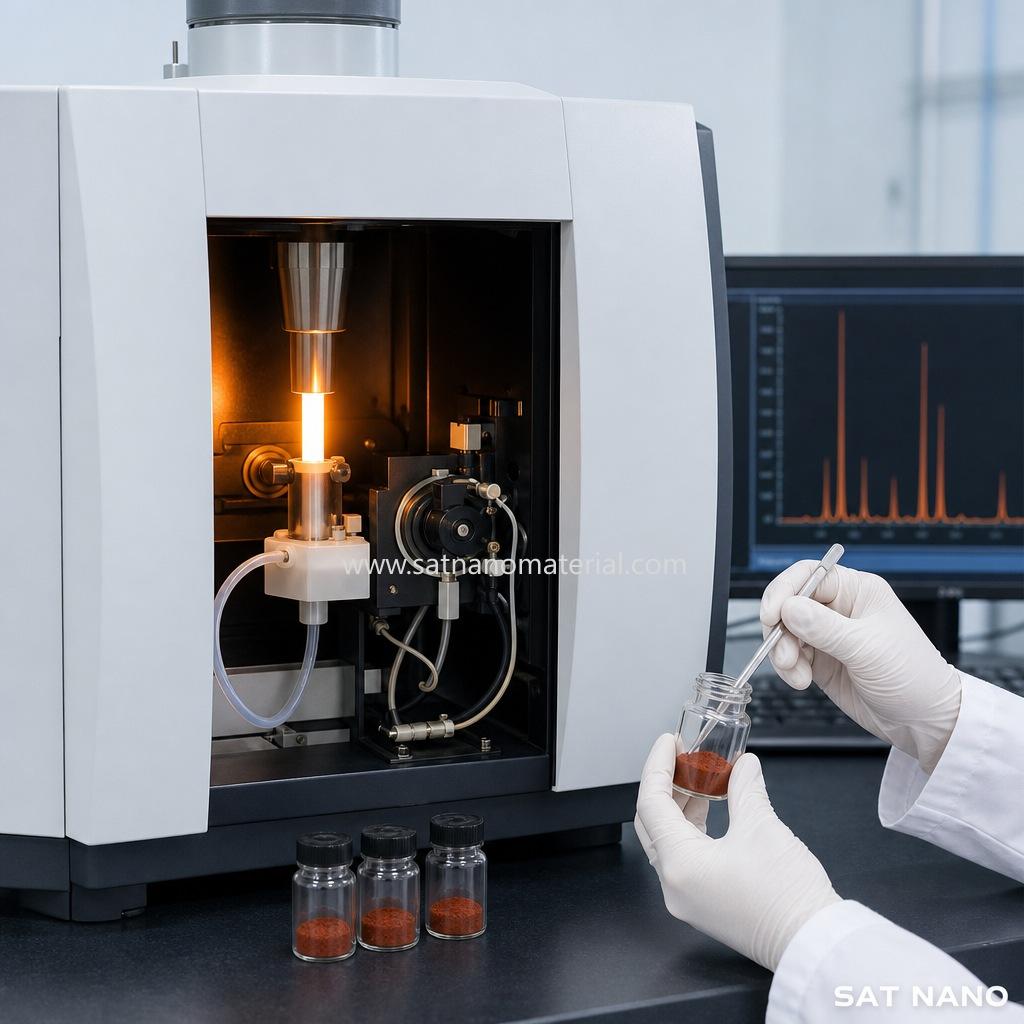
Instrumentation: ICP-OES (major Fe + common impurities, ppm level) / ICP-MS (trace impurities, ppb level)
1. Method Overview
-
ICP-OES (Inductively Coupled Plasma – Optical Emission Spectrometry): major Fe content + common impurities (0.001%–100%), fast and cost-effective
-
ICP-MS (Inductively Coupled Plasma – Mass Spectrometry): trace impurities at ppb level, highest sensitivity
-
ICP measurestotal element content only: it cannot distinguish α/γ phases (use XRD), cannot distinguish Fe²⁺/Fe³⁺ (use titration/XPS), andcannot measure oxygen(use inert-gas fusion or elemental analyzer)
2. Sample Preparation (the critical step: digestion)
α-Fe₂O₃ is a high-temperature calcination product — dense lattice and chemically inert. Digestion determines success or failure.The higher the calcination temperature, the harder to dissolve.
Option A: Microwave digestion (recommended — sealed, high temperature/pressure, most thorough)
-
Sample: 0.1–0.2 g (dry at 105°C to constant weight first; report on a dry basis)
-
Reagents:6 mL conc. HCl + 2 mL conc. HNO₃ (aqua regia system); add 0.5–1 mL HF if Si is to be measured or silica-containing impurities are present (must use PFA/Teflon vessels — never glass)
-
Example program: ramp to 180–200°C, hold 20–30 min, cool before opening
-
If residue remains: repeat with fresh aqua regia, or add HF
Option B: Ambient-pressure heating digestion (alternative without microwave)
-
20–30 mL conc. HCl (or aqua regia), heat near boiling under reflux for 1–2 h; extend as needed
-
Highly calcined samples (>800°C) often require repeated acid additions or a small amount of reducing aid (e.g., SnCl₂, ascorbic acid — reducing Fe³⁺ to Fe²⁺ accelerates dissolution)
Option C: Alkali fusion (last resort)
-
Lithium metaborate (LiBO₂) or Na₂CO₃ fusion at high temperature, then acid leach
-
Drawback: introduces a large salt load (high TDS) → severe interferences and high dilution.Use only if nothing else dissolves the sample.
HF safety note: HF attacks glass and the quartz nebulizer/torch. Solutions containing HF require anHF-resistant sample introduction system, or complexation with boric acid before aspiration; always work in a fume hood with dedicated protective gloves.
3. Post-digestion Handling
-
Transfer the digestate to a volumetric flask (PFA/plastic), make up with ultrapure water (e.g., 100 mL)
-
Dilute into measurement range: Fe major 10–100 ppm; impurities as required
-
Match acidity between samples and standards(typically 1–5% acid) to avoid nebulization differences
-
Addinternal standards(ICP-OES: Sc, Y; ICP-MS: Sc, In, Rh) to correct matrix effects and drift
4. Instrument Conditions and Spectral Lines
-
Recommended lines (interference-minimized):
-
Fe: 259.94 nm, 238.20 nm (ICP-OES)
-
Impurities: Al 396.15 / Na 589.59 / K 766.49 / Ca 393.37 / Mg 279.55 / Mn 257.61 / Cu 324.75 / Pb 220.35 / Cd 228.80 / Cr 267.72 / Ni 231.60 / Zn 213.86 / Si 251.61 nm
-
Verify each element with ≥2 lines
-
Matrix effect: high Fe concentration suppresses/enhances impurity signals —matrix-match the calibration with an Fe base(standard addition is the most accurate)
5. Calibration and Quality Control
-
Fe standard: pure iron (≥99.99%) or Fe single-element standard solution; impurities from a multi-element mixed standard
-
Run areagent blankthrough the entire procedure (same acids, same digestion flow, same HF amount if used)
-
Spike recovery: 90–110% passes
-
≥2 replicates; RSD < 5%
-
Trace analysis: pre-clean digestion vessels with acid soak + ultrapure water rinse to avoid cross-contamination
6. Results and Reporting
-
Fe content: convert the measured Fe concentration (blank-corrected); for purity, usePurity = 100% − Σ (impurity contents)(difference method) — the impurity list must cover the customer/standard requirement (e.g., GB/T, ASTM, customer COA specification)
-
Report on adry basis: state drying conditions and moisture/LOI
-
Suggested report contents: Fe content, individual impurity contents, method (incl. digestion), spectral lines, detection limits, spike recovery, uncertainty



 online service
 13929258449
 admin@satnano.com
 + 8613929258449


