This guide provides a comprehensive technical framework for utilizing magnetite (Fe3O4) nanopowder as a functional filler to formulate industrial protective coatings with superior antistatic and electromagnetic shielding properties. It specifically addresses critical engineering challenges such as nanoparticle agglomeration, sedimentation, percolation threshold optimization, and coating adhesion.
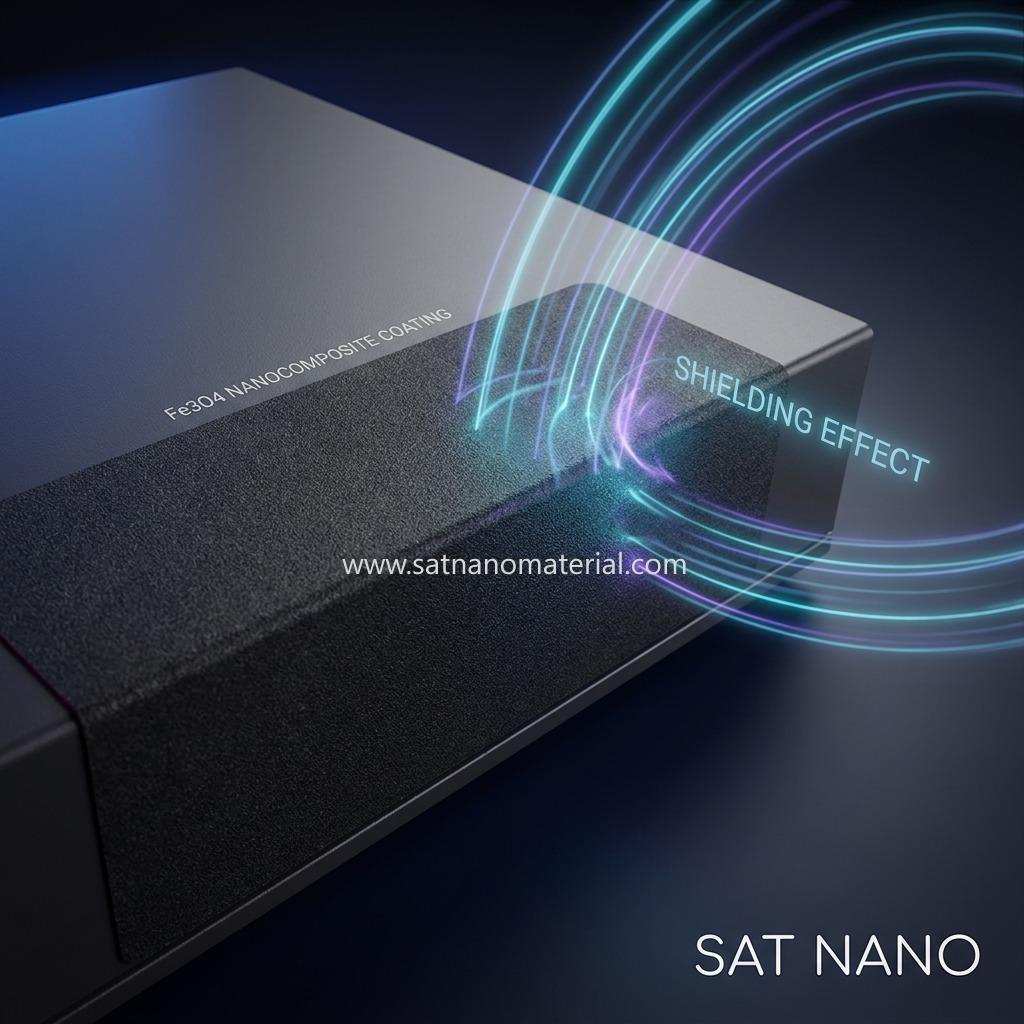
1.1 Dual Conductive and Magnetic Mechanisms
-
Electrostatic Discharge (ESD) / Antistatic: Magnetite (Fe3O4) is a semiconductor with a room-temperature resistivity of approximately 10−210−2 to 10−3 Ω⋅cm10−3 Ω⋅cm. Once uniformly dispersed in a polymer matrix at a sufficient concentration, the nanoparticles contact each other (or utilize the tunneling effect) to establish a continuous conductive network, allowing static charges to bleed off safely.
-
Electromagnetic Interference (EMI) Shielding: Unlike purely carbonaceous or metallic conductive coatings, Fe3O4 is ferrimagnetic. When electromagnetic waves impinge on the coating, it attenuates the magnetic component through hysteresis loss, domain wall resonance, and eddy current losses, absorbing electromagnetic radiation.
1.2 Single-Filler Limitations and Synergistic Networks
Due to the moderate intrinsic resistivity of Fe3O4 compared to pure metals (Ag, Cu, Ni), relying solely on Fe3O4 to achieve a high shielding rating (surface resistivity <104 Ω/sq) requires high loading levels (typically 30%∼50%30%∼50% by weight). This severe loading dramatically increases coating viscosity, compromises mechanical properties (brittleness), and severely weakens substrate adhesion.
-
Recommended Solution: A "Fe₃O₄ / Carbonaceous Filler" Synergistic Conductive Network. Introducing a minor fraction (0.5%∼1.5%0.5%∼1.5% by weight) of Multi-Walled Carbon Nanotubes (MWCNTs) or conductive carbon black allows them to act as "conductive bridges" connecting the Fe3O4 nanoparticles. This dramatically lowers the percolation threshold, multiplies electrical conductivity, and reduces the necessary Fe3O4 loading to a manageable 15%∼25%15%∼25%.
Ingredient
|
Recommended Specification
|
Weight Parts (pbw)
|
Function / Mechanism
|
Film-Forming Binder
|
Epoxy Resin E-51 (DGEBA)
|
100
|
Primary binder; provides excellent corrosion resistance and mechanical adhesion
|
Reactive Diluent
|
Butyl Glycidyl Ether (BGE)
|
10 ~ 15
|
Reduces initial resin viscosity for easier filler incorporation
|
Primary Functional Filler
|
Modified Fe3O4 Nanopowder (20 ~ 50 nm)
|
25 ~ 35
|
Conductive and magnetic absorber core
|
Co-Filler (Optional)
|
Multi-Walled Carbon Nanotubes (MWCNTs)
|
0.5 ~ 1.5
|
Bridges nanoparticles to establish a robust conductive network
|
Wetting & Dispersing Agent
|
High-molecular-weight block copolymer (e.g., BYK-110)
|
1.0 ~ 2.0
|
Steric stabilization; lowers viscosity and prevents agglomeration
|
Anti-Settling Agent
|
Fumed Silica (e.g., Aerosil 200 or modified)
|
0.8 ~ 1.5
|
Builds a thixotropic network to prevent heavy iron settling
|
Leveling & Defoaming Agents
|
Polyether-modified silicone
|
0.3 ~ 0.5
|
Eliminates air bubbles and micro-pinholes, ensuring a smooth finish
|
Solvent Blend
|
Xylene : Butanone : Butyl Acetate = 4:3:3
|
~30 ~ 50
|
Adjusts viscosity to standard application parameters (20-30s, Ford Cup #4)
|
Curing Agent (Part B)
|
Polyamide Curing Agent (e.g., Polyamide 650)
|
50 ~ 60
|
Crosslinks with Part A at room or elevated temperature
|
3. Step-by-Step Preparation Process
Nanoparticles possess extremely high surface energy and naturally form tight secondary agglomerates. Standard low-shear mixing is insufficient to break these structures. The following four-stage protocol must be :
Stage 1: Surface Chemical Modification (Wet Silanization)
This stage replaces hydrophilic surface hydroxyls with organophilic chains, preventing re-agglomeration and enhancing compatibility with organic resins.
-
Prepare Hydrolysis Solution: Mix anhydrous ethanol and deionized water (95:5 wt. ratio). Add Silane Coupling Agent KH-550 (equivalent to 1.5%∼2.0%1.5%∼2.0% of the weight of Fe3O4). Adjust the pH to 4.0 ~ 5.0 using glacial acetic acid. Stir at room temperature for 30 minutes to ensure full hydrolysis of the silane.
-
Ultrasonic Dispersion: Disperse the Fe3O4 nanopowder in the silane solution. Subject the suspension to high-intensity ultrasonic treatment for 30 ~ 45 minutes to disrupt loose physical clusters.
-
Reflux Reaction: Transfer the suspension to a three-necked flask equipped with a mechanical stirrer and a reflux condenser. Heat to 75 ~ 80 °C under vigorous stirring for 3 hours.
-
Washing & Collection: Cool the mixture. Position a strong neodymium-iron-boron (NdFeB) magnet under the flask to magnetically separate the Fe3O4 nanoparticles. Decant the supernatant, replenish with anhydrous ethanol, and repeat the washing cycle 3 times to remove any unreacted silane.
-
Drying & Pulverization: Dry the wet paste in a vacuum oven at 70 °C for 12 hours. Gently mill the dried cake back into a fine, organophilic Fe3O4 powder.
-
Charge the epoxy resin, reactive diluent, solvents, and the wetting/dispersing agent (BYK-110) into a mixing vessel.
-
Set the high-speed dissolver to 500 rpm. Gradually charge the modified Fe3O4 nanopowder and the carbon co-fillers.
-
Increase the shear speed to 1500 ~ 2000 rpm and disperse for 30 ~ 45 minutes to wet the fillers thoroughly.
Stage 3: High-Energy Bead Milling (Critical Step)
-
Bead Milling: Pump the pre-mixed slurry into a horizontal bead mill charged with 0.2 ~ 0.4 mm yttria-stabilized zirconia beads (70~80% filling ratio).
-
Temperature Control: Run the slurry through 3 ~ 4 passes. Keep the mill's cooling jacket active, maintaining the product temperature below 50 °C to prevent premature resin polymerization.
-
Fineness Verification: Check the fineness using a hegman gauge. Stop milling once the reading is ≤10 μm≤10 μm and the paste possesses a glossy, buttery texture.
Stage 4: Post-Addition & Stabilization
-
Blend in the leveling agent, defoamer, and the pre-dispersed fumed silica paste at 800 rpm.
-
Filter the coating base through a 200-mesh (75 μmμm) screen to eliminate any stray particles. Package and seal as Part A (Base).
4. Coating Application Guide
Adhesion dictates the longevity and reliability of the shielding layer.
-
Metal substrates (Steel, Aluminum enclosures): Solvent degrease, then grit-blast (Sa 2.5) or abrade to profile the surface.
-
Plastic substrates (ABS, PC): Clean with isopropyl alcohol to remove mold release agents. Consider plasma treatment or a light plastic primer to promote chemical bonding.
-
Blend Part A (Base) and Part B (Curing Agent 650) at a 100 : 50 weight ratio (or as specified by the curing agent's amine value).
-
Adjust viscosity by adding the solvent blend under mechanical agitation.
-
Induction (Aging) Time: Let the mixture stand for 15 ~ 20 minutes before spraying. This initiates pre-polymerization and helps expel microbubbles.
-
Pot Life: Use the catalyzed paint within 4 hours; discard if gelation begins.
-
Pneumatic Air Spraying is highly recommended to achieve a uniform, isotropic network. Use a nozzle size of 1.2 ~ 1.5 mm and air pressure of 0.3 ~ 0.5 MPa.
-
Apply in multiple wet-on-wet passes (15∼20 μm15∼20 μm per pass) with a 10-minute flash-off time between passes. Aim for a total dry film thickness (DFT) of 35 ~ 50 μmμm.
-
Ambient Cure: Dry-to-touch in 2 hours, hard-dry in 24 hours (full chemical cure in 7 days at 25 °C).
-
Forced Cure (Recommended): Allow a 30-minute flash-off, then bake in an oven at 80 °C for 2 hours. Thermal curing induces matrix shrinkage, compressing the conductive fillers closer together to yield a superior conductive/shielding performance.
-
Surface Resistivity:
Measure via a 4-point probe or high-resistance meter.
-
Antistatic Threshold: Surface resistivity should fall between 105∼109 Ω/sq105∼109 Ω/sq.
-
Electrostatic/EMI Shielding Grade: Surface resistivity <104 Ω/sq<104 Ω/sq (achievable with the Fe3O4Fe3O4/MWCNT co-filler formulation).
-
Cross-Cut Adhesion:
Per GB/T 9286 or ASTM D3359, the coating must achieve a rating of Class 0 or 1 (no peeling).
-
EMI Shielding Effectiveness (SE):
Evaluate in the 30 MHz ~ 1.5 GHz band using a coaxial flange test fixture (ASTM D4935) to measure attenuation in decibels (dB).
6. Engineering Pitfalls & Best Practices
-
The Settling Catastrophe:
The density of Fe3O4 (5.18 g/cm35.18 g/cm3) is far higher than that of epoxy resin (approx. 1.2 g/cm31.2 g/cm3). Unstabilized nanoparticles settle into an extremely hard sediment that cannot be re-dispersed.
-
Mitigation: Never omit the fumed silica or polyamide wax (thixotropic agent). This creates a strong yield stress under static conditions to lock the nanoparticles in place, while thinning immediately under shear.
-
Thermal Oxidation Risk:
Nanoparticles have extremely high chemical activity. If the temperature spikes during milling or drying, magnetite can oxidize into hematite (α-Fe2O3α-Fe2O3), which is non-magnetic and poorly conductive (destroying the shielding properties). Always maintain the water-cooling jacket during milling.
-
Stoichiometric Precision:
Always weigh the curing agent precisely. Epoxies do not dry by evaporation; they cure via stoichiometry. An incorrect ratio leads to sticky film or brittle, highly stressed coatings that crack and break the shielding pathways.



 online service
 13929258449
 admin@satnano.com
 + 8613929258449


