


CAS 7440-05-3 Pd nanopowder Ultrafine Palladium as catalyst
Size:20-30nm Purity:99.95% CAS No:7440-05-3 ENINEC No.:231-115-6 Appearance:black Powder Shape:spherical

Size:20-30nm Purity:99.95% CAS No:7440-05-3 ENINEC No.:231-115-6 Appearance:black Powder Shape:spherical
We can supply different size products of niobium silicide powder according to client's requirements. Size:1-3um; Purity:99.5%;Shape:granular CAS No:12034-80-9;ENINEC No.:234-812-3
Ni2Si particle,99.5% purity,granular shape,is used for Microelectronic integrated circuit, nickel silicide film,etc. Size:1-10um; CAS No:12059-14-2;ENINEC No.:235-033-1
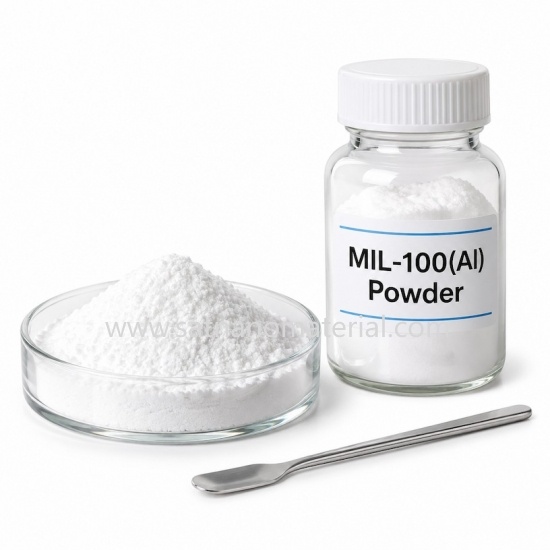
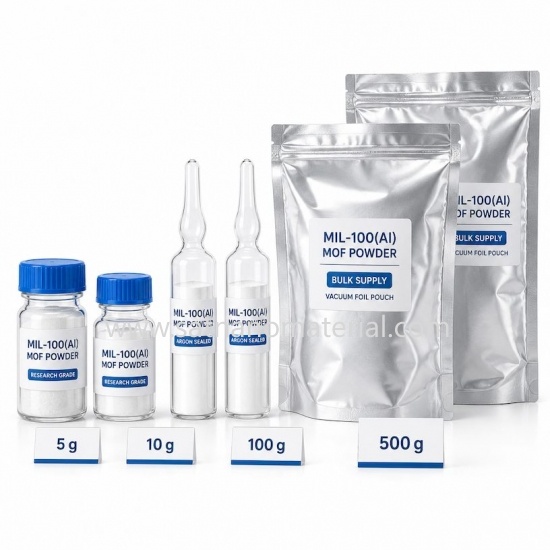
Supply High Purity MOF Metal Organic Framework KAUST-7 powder, particle size 0.6-1.1um, high quality, high purity and cheap price, fast delivery, please check the specification.
Brand:
SAT NANOItem NO.:
SAT-KAUST-7Payment:
TT, Paypal, WUProduct Origin:
ChinaColor:
purple grey PowderShipping Port:
Shenzhen, ShanghaiLead Time:
1-5daysMin Order:
1gKAUST-7 has high chemical and thermal stability, as well as excellent water and H2S resistance, making it an ideal candidate material for applications under harsh conditions. In addition, compared to H2 and CH4, KAUST-7 has high adsorption selectivity for CO2 and still has high carbon dioxide adsorption capacity at a concentration of 400ppm, making it a very attractive candidate material for air carbon capture projects.
| CAS No. | 1973399-07-3 |
|
Lateral size |
0.6-1.1um |
| Color | purple grey powder |
| SSA | >=200m2/g |
| aperture | 0.3-0.5nm |
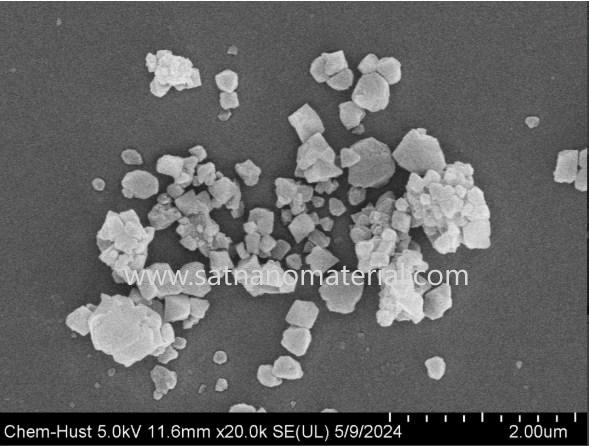
Approximate formula:Al₃OCl(H₂O)₂(BTC)₂, where BTC is trimesic acid. It isfully isostructuralwith MIL-100(Cr) — the same large-cage plus narrow-window framework, with aluminium in place of chromium.
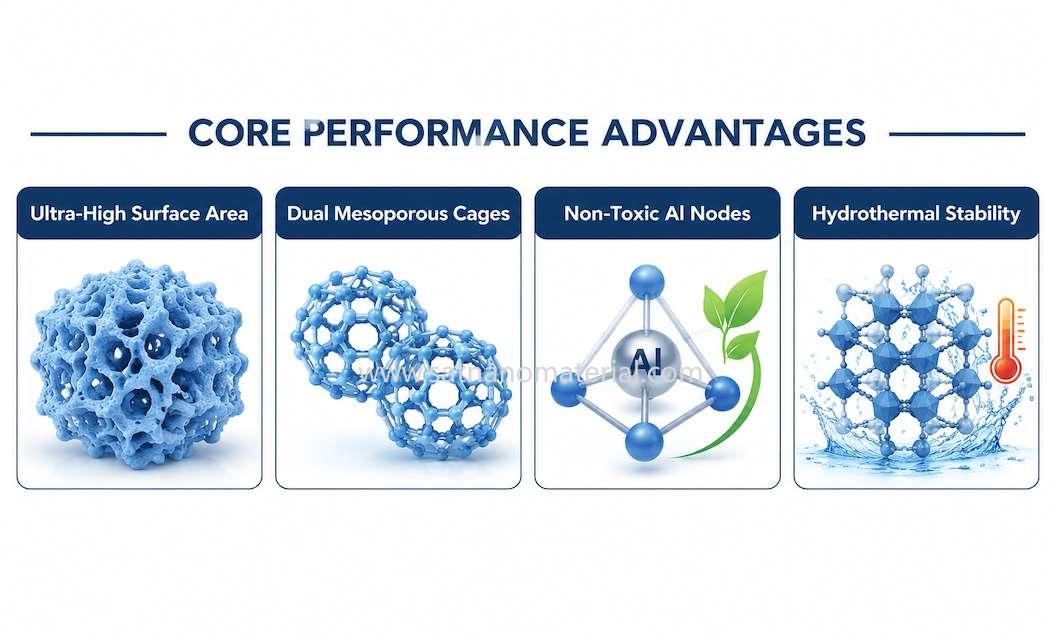
1. The "large cage + narrow window" structure is fully retained— cavities of roughly 2.5–2.9 nm with windows of only about 0.55 nm and 0.86 nm,able to hold macromolecules while restricting their free passage in and out, giving intrinsic size selectivity; this is its core difference from MIL-101(Al).
2. Specific surface area below the Cr version— literature values around the 1500–2200 m²/g level, still a high-surface-area mesoporous MOF.
3. S-shaped water adsorption isotherm— a steep rise across the mid-humidity range, andthe absence of chromium makes it a far more deployable candidate for adsorption heat pumps and desiccant wheels
4. Moderate-to-good thermal stability— decomposition generally begins in the roughly 300–400 °C range, weaker than the Cr version but sufficient for water adsorption and routine catalysis
5. Moderate water stability— better than MIL-101(Fe), butbelow MIL-100(Cr) and well below MIL-53(Al); unsuitable for prolonged boiling-water or strongly acidic/basic duty
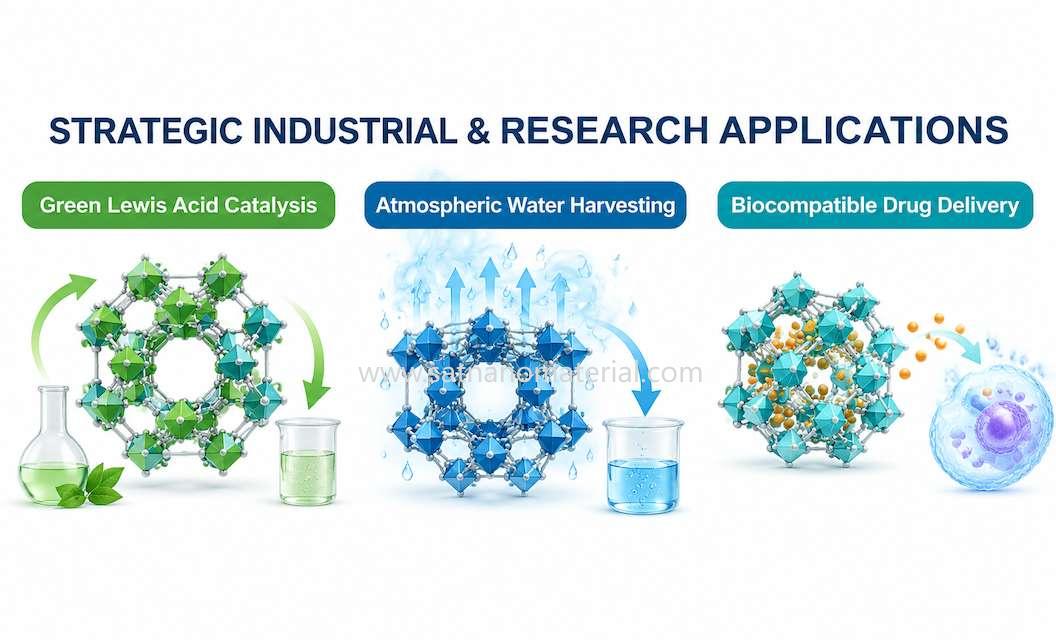
1. Adsorption heat pumps / chillers / dehumidification— the most promising direction: S-shaped water adsorption plus chromium-free compliance, suited to building HVAC and industrial waste-heat recovery
2. Shape-selective adsorption and separation— molecular-size sieving, isomer separation and capture of specific molecules via the narrow windows.
3. Gas storage and separation— CO₂, CH₄ and H₂ adsorption; CO₂/N₂ separation.
4. Solid acid catalysis— acetalisation, esterification, Friedel–Crafts, CO₂ cycloaddition.
5. Encapsulation and controlled release of active molecules— large cages for loading and narrow windows to limit leakage, suited to fragrance, drug and sustained-release carrier research
6. Water-treatment adsorption— dyes, antibiotics, PFAS and other macromolecular pollutants
MOF Metal Organic Framework KAUST-7 should be sealed and stored in a dry and cool environment. It should not be exposed to the air for a long time, to prevent agglomeration due to moisture, affecting the dispersion performance and use effect, and should avoid heavy pressure, do not contact with oxidant, and transport according to ordinary goods.
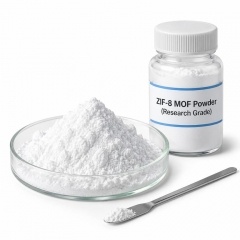
Supply High Purity Trinitrogen Doped Graphdiyne Powder, lateral size 100-200nm,200-400nm, 500-800nm, high quality, high purity and cheap price, fast delivery, please check the specification.
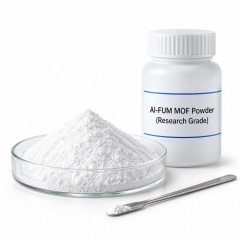
Supply High Purity MOF Metal Organic Framework Al-FUM powder, lateral size 15-20um, high quality, high purity and cheap price, fast delivery, please check the specification.
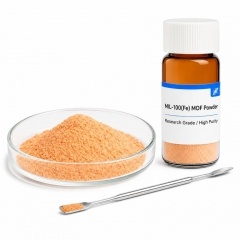
Supply High Purity MOF Metal Organic Framework MIL-100(Fe) powder, lateral size 200-500nm, high quality, high purity and cheap price, fast delivery, please check the specification.
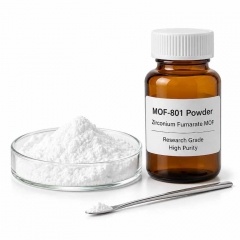
Supply High Purity MOF Metal Organic Framework MOF-801 powder, lateral size 600nm, high quality, high purity and cheap price, fast delivery, please check the specification.
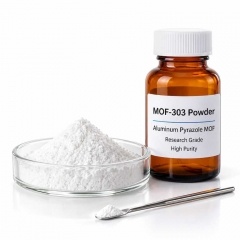
Supply High Purity MOF Metal Organic Framework MOF-303 powder, particle size 0.2um, high quality, high purity and cheap price, fast delivery, please check the specification.
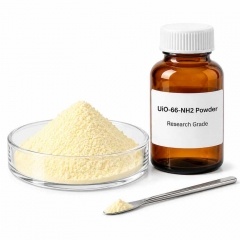
Supply High Purity MOF Metal Organic Framework UIO-66-NH2 powder, particle size 100-200nm, high quality, high purity and cheap price, fast delivery, please check the specification.
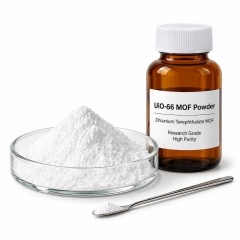
Supply High Purity MOF Metal Organic Framework UiO-66 powder, particle size 100-200nm, high quality, high purity and cheap price, fast delivery, please check the specification.
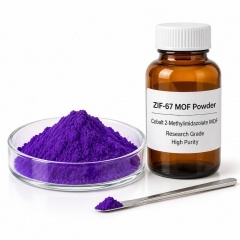
Supply High Purity MOF Metal Organic Framework ZIF-67 powder, particle size 400-500nm, high quality, high purity and cheap price, fast delivery, please check the specification.
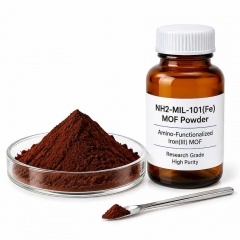
Supply High Purity MOF Metal Organic Framework NH2-MIL-101(Fe) powder, particle size 0.8-1um, high quality, high purity and cheap price, fast delivery, please check the specification.
Supply High Purity MOF Metal Organic Framework MIL-101(Fe) powder, particle size 0.8-1um, high quality, high purity and cheap price, fast delivery, please check the specification.
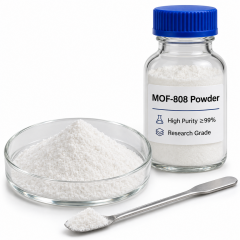
Supply High Purity MOF Metal Organic Framework MOF-808 powder, particle size 1um, high quality, high purity and cheap price, fast delivery, please check the specification.
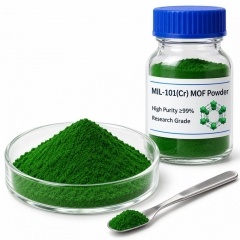
Supply High Purity MOF Metal Organic Framework MIL-101(Cr) powder, particle size 100-200nm, high quality, high purity and cheap price, fast delivery, please check the specification.


 online service
 13929258449
 admin@satnano.com
 + 8613929258449