


CAS 7440-05-3 Pd nanopowder Ultrafine Palladium as catalyst
Size:20-30nm Purity:99.95% CAS No:7440-05-3 ENINEC No.:231-115-6 Appearance:black Powder Shape:spherical

Size:20-30nm Purity:99.95% CAS No:7440-05-3 ENINEC No.:231-115-6 Appearance:black Powder Shape:spherical
We can supply different size products of niobium silicide powder according to client's requirements. Size:1-3um; Purity:99.5%;Shape:granular CAS No:12034-80-9;ENINEC No.:234-812-3
Ni2Si particle,99.5% purity,granular shape,is used for Microelectronic integrated circuit, nickel silicide film,etc. Size:1-10um; CAS No:12059-14-2;ENINEC No.:235-033-1
In the field of quantum dot light-emitting diodes (QLEDs), CdSe based quantum dots have been widely studied and have achieved excellent performance in red and green emitting QLEDs. However, to achieve blue luminescence, CdSe nuclei need to become extremely small (diameter<2nm), which can lead to unstable surface properties, resulting in lower external quantum efficiency (EQE) of blue QLEDs compared to red and green QLEDs.
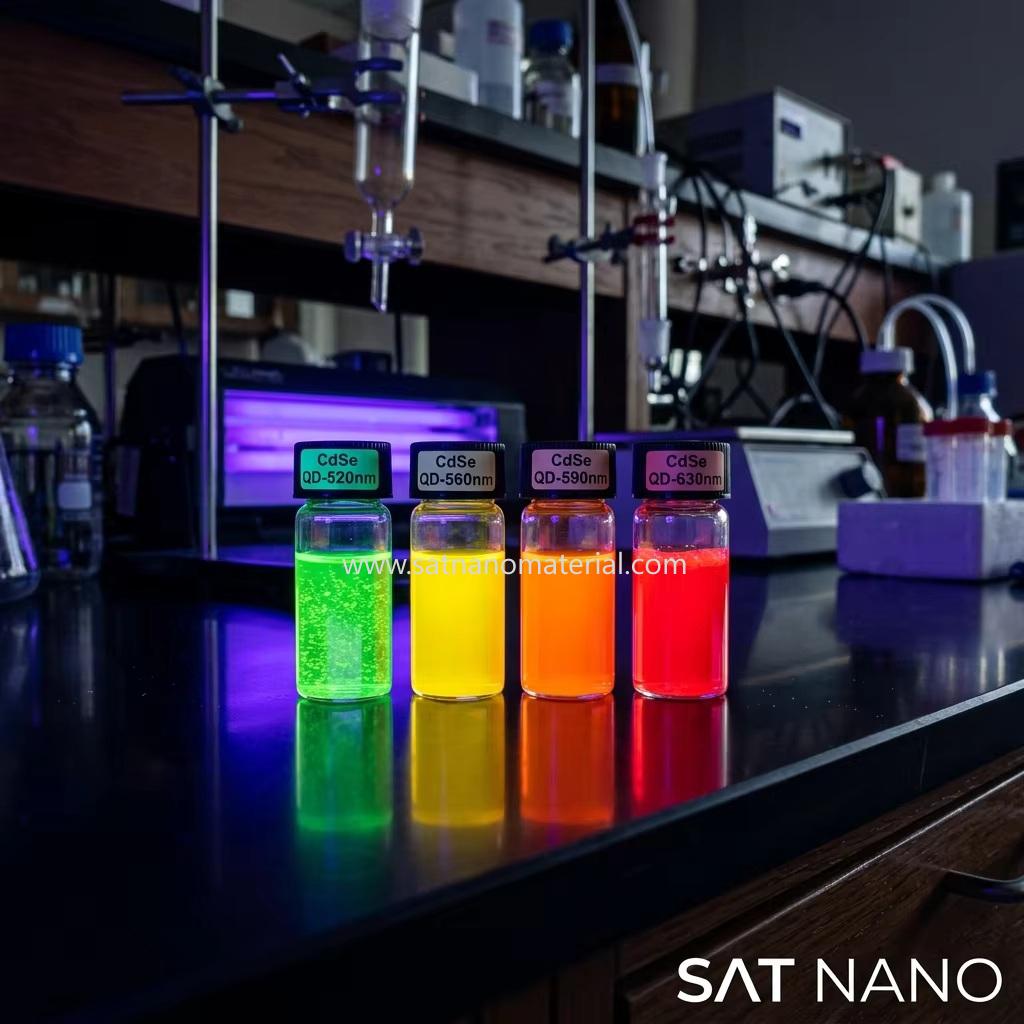
The journal Angew reports that researchers have successfully prepared high-performance blue QLED devices by designing and synthesizing g-CdZnSeS/ZnS quantum dots with unique structures, achieving a breakthrough EQE of up to 24%. The optimized gradient component released the core/shell lattice stress. Due to the suppression of exciton transfer and Auger recombination, the external quantum efficiency (EQE) of blue QLEDs with large CdZnSeS alloy nuclei has achieved a breakthrough of 24%.
In this work, researchers synthesized a giant CdZnSeS alloy core by diffusing zinc atoms into the CdSeS core, which can optimize the gradient composition and release the core/shell lattice stress. The outer shell is composed of 1-2 single-layer ZnS layers, resulting in a gradient change in the composition of the entire quantum dot. This structural design not only effectively suppresses exciton transfer and Auger recombination, but also lowers the Fermi level, thereby improving the internal confinement of excitons. g-CdZnSeS/ZnS quantum dots exhibit monodispersity and a photoluminescence quantum yield (PLQY) of up to 95%.
Based on the excellent performance of quantum dots, researchers have prepared QLED devices using polyvinyl carbazole (PVK) as the hole transport layer and ZnMgO nanoparticles as the electron transport layer. The results show that the maximum brightness of g-CdZnSeS/ZnS QLED devices is about 57000 cd/m2, the turn-on voltage is about 3.8V, and the maximum EQE is about 24%, while the maximum EQE of QLED devices based on the other two core/shell structures is only 8%.
In addition, the EQE of 48 devices prepared through different batches of experiments was mainly concentrated in the range of 21% -24%, showing excellent repeatability. At different voltages of 3-9V, the peak value of the electroluminescence (EL) spectrum stabilizes at 479nm. At a constant current density of 8000cd/m2, the working life (T50) of the device is 10 hours, and it can be inferred that the T50 at an initial brightness of 100cd/m2 is approximately 27000 hours.

The method proposed in this work provides valuable insights and guidance for developing high-performance blue QLEDs. Future research can further optimize the synthesis methods of quantum dots and the device structure of QLEDs to achieve higher efficiency and stability.
Literature name: Improving Internal Exciton Confinement for Efficient CdZnSeS-Based Blue Quantum Dot Light-Emitting Diodes


 online service
 13929258449
 admin@satnano.com
 + 8613929258449